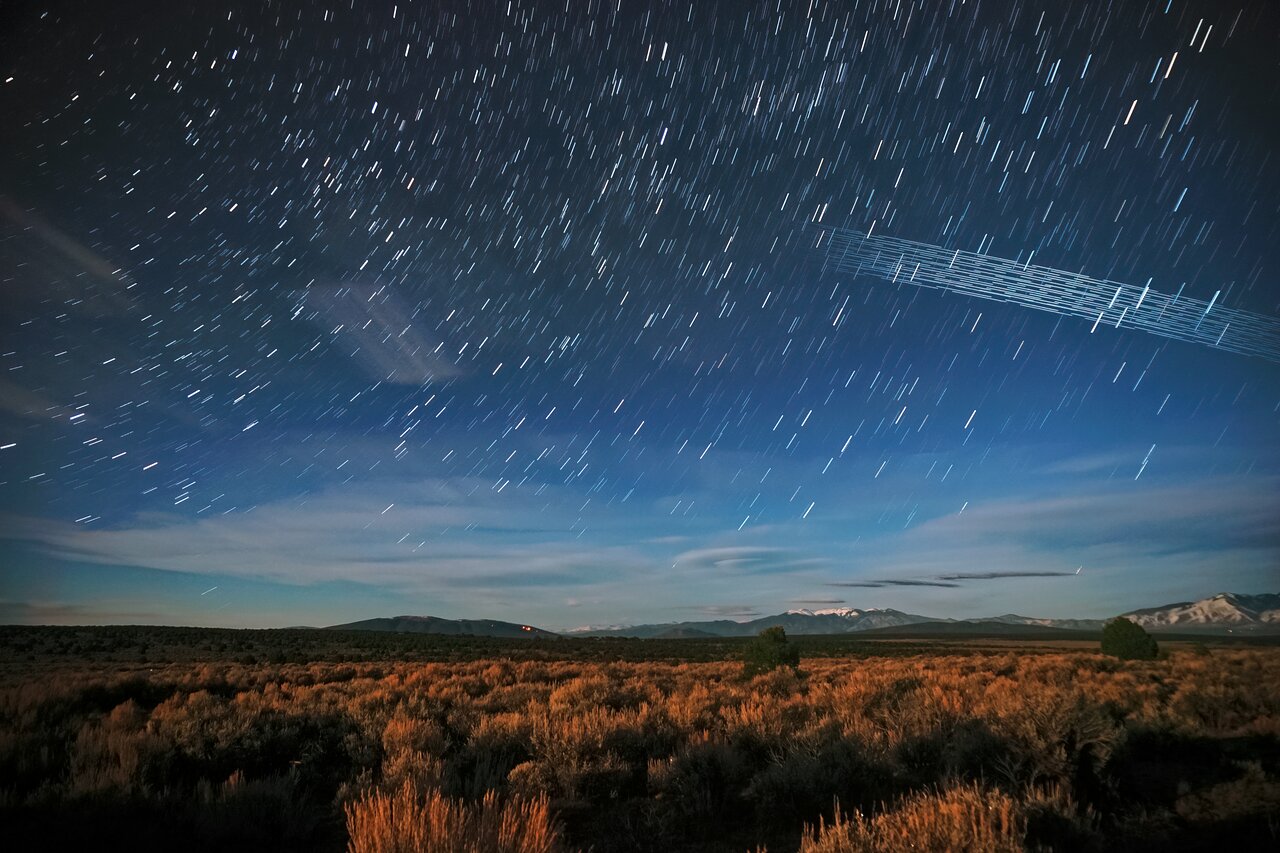
Credit: Mike Lewinsky/Creative Commons Attribution.
How CuriousPilot Estimates Starlink Flares
A short summary of the physics, the model, and the version-specific brightness curves CuriousPilot uses to predict and render Starlink flares.
What a Starlink flare is
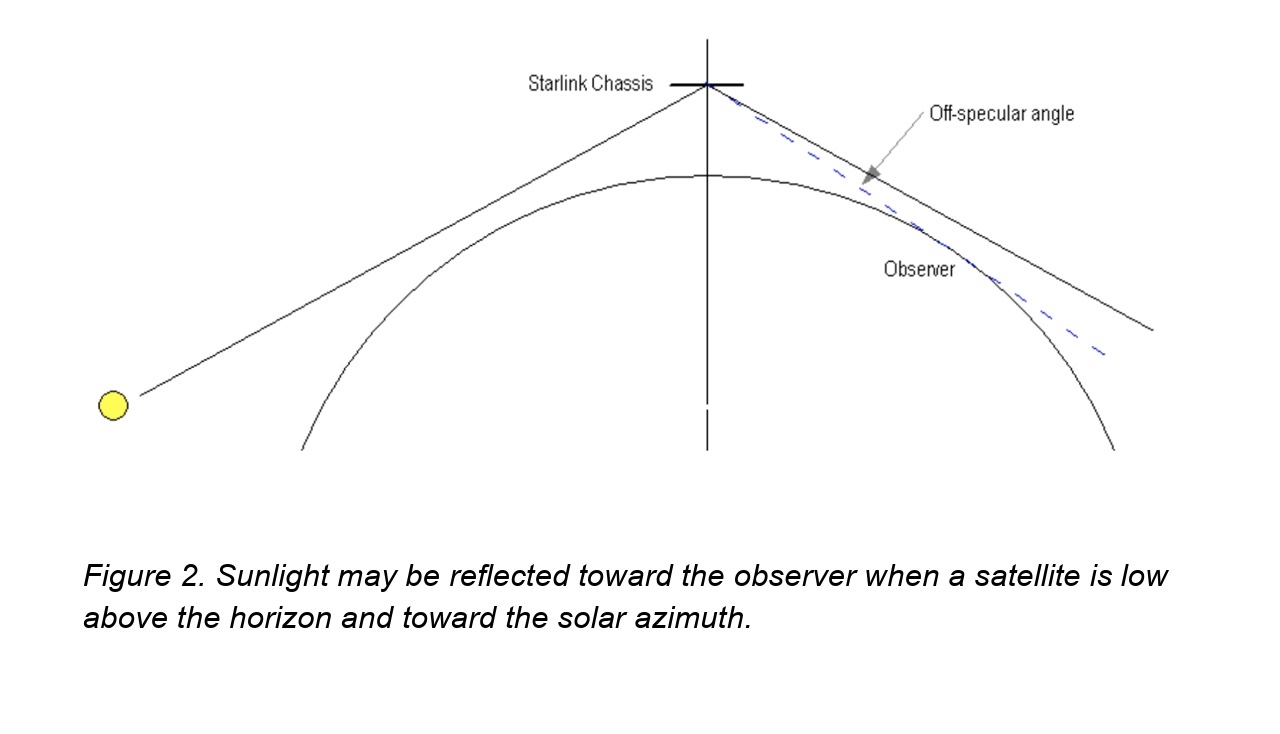
Starlink satellites fly with their flat chassis facing Earth. When sunlight strikes that chassis at just the right angle relative to an observer on the ground (or in an aircraft), the chassis acts like a mirror and reflects a concentrated beam of sunlight in the observer's direction. The satellite briefly appears far brighter than usual — sometimes by 5 to 10 magnitudes, or roughly 100 to 10,000 times its normal brightness. This is a specular flare.
Flares sometimes appear red or orange rather than white. Near twilight — when the sun is below the observer’s horizon but still illuminating the satellite overhead — the sunlight reaching the chassis has grazed through Earth’s atmosphere along a long, low-angle path. That path scatters away the shorter blue and green wavelengths, leaving the longer red and orange wavelengths behind. The chassis then reflects this already-reddened light back to the observer. It is the same physics that gives sunsets their warm color: the satellite is, in effect, mirroring sunset light down from orbit.
How CuriousPilot detects a flare
For every Starlink satellite, on every simulation frame, CuriousPilot computes the angle between two directions in the sky as seen from the satellite:
- the direction sunlight would bounce if the chassis acted as a perfect mirror (the specular direction);
- the direction back to the observer.
The difference between these two directions is the off-specular angle. When it falls below about 5°, the satellite is inside the flare cone and CuriousPilot flags it as flaring. A separate test confirms that sunlight actually reaches the Earth-facing side of the satellite — flares are impossible if the sun is on the wrong side of the chassis.
How CuriousPilot estimates the brightness
The brightness model is based on Mallama & Cole 2024, “Extreme Flaring of Starlink Satellites”. The paper presents one empirical curve per Starlink generation relating off-specular angle to apparent magnitude (adjusted to a standard 1,000 km observer range):
m(θ) = a + b × log10(θ)
The closer the satellite is to perfect specular alignment, the
brighter it gets, with a saturation cap at magnitude
−5 (the brightest flare value reported in
the paper). The curve coefficients a and b
differ substantially between generations.
Starlink generations differ dramatically
SpaceX has launched four major Starlink generations with different chassis materials, coatings, and visor designs. Each has its own brightness curve. The table below lists the predicted magnitude at three representative off-specular angles (lower magnitude = brighter):
| Generation | Era | at 0.5° | at 2° | at 5° | Notes |
|---|---|---|---|---|---|
| V1.0 | 2019–2020 | −5.0 | 0.0 | +1.4 | Original chassis, no sun visor. |
| VisorSat | Aug 2020 – mid 2021 | −5.0 | −1.0 | +2.6 | Steepest log-slope of the four — brightest just past the saturation plateau, then dims faster than the others as the angle grows. |
| V1.5 | 2021–2022 | −5.0 | +0.25 | +1.85 | Dielectric coating; most precisely characterized curve. |
| Mini (V2 Mini) | 2023 onward | −5.0 | +1.0 | +2.4 | Dimmest at small angles; dielectric film + edge-on solar arrays. |
At dead-center alignment all four generations saturate around magnitude −5. The spread between versions is widest just past the saturation plateau (around 1°), where it reaches roughly 3.5 magnitudes — about a 25× brightness difference, with VisorSat the brightest. As the angle grows, VisorSat’s steep slope causes it to dim faster than the others, so the differences narrow toward the cone boundary: by 2° the spread is about 2 magnitudes, and by 5° all four versions sit within roughly 1.2 magnitudes of each other.
How each satellite is classified
Public satellite catalogs do not record a Starlink’s
generation directly, so CuriousPilot infers it from the
Starlink launch number embedded in the satellite’s
name (for example, STARLINK-3145):
- SL number < 2000 → V1.0
- SL number 2000–2999 → VisorSat
- SL number 3000–29999 → V1.5
- SL number 30000+ → Mini
A small per-satellite override file lets known mis-classifications be corrected by hand. When the generation cannot be determined, CuriousPilot falls back to the V1.5 curve (the most precisely measured of the four, and a defensible middle ground).
Known limitations
- Direct-to-Cell Starlinks are not separately modeled. The Mallama & Cole paper does not characterize the DTC variant. DTC satellites fall back to the V1.5 curve, which is an approximation — their large phased-array antennas likely give them a different reflective signature.
- Curve uncertainty varies by generation. The V1.5 curve is anchored to a published BRDF measurement and is accurate to roughly ±0.1 magnitude. The V1.0, VisorSat, and Mini curves were eyeball-read from the paper’s plots and carry an uncertainty of roughly ±0.5 magnitude.
- Chassis attitude is assumed nadir-pointing. The model assumes the broad face is held facing Earth, which is the standard Starlink operational orientation. Satellites that are slewing or in a non-nominal attitude can flare in directions the model will not anticipate.
References
- Mallama, A. & Cole, R. E. (2024). Extreme Flaring of Starlink Satellites. arXiv:2405.13091. https://arxiv.org/abs/2405.13091
- Mallama, A. (2021). Starlink satellite brightness — characterized from 100,000 visible light magnitudes. arXiv:2111.09735. https://arxiv.org/abs/2111.09735
- Mallama, A. (2022). The method of visual satellite photometry. arXiv:2208.07834. https://arxiv.org/abs/2208.07834
- Mallama, A., Cole, R. E., Respler, J., Bassa, C., Harrington, S. & Worley, A. (2024). Starlink Mini satellite brightness distributions across the sky. arXiv:2401.01546. https://arxiv.org/abs/2401.01546
- Buettner, D. J., Griffiths, R. E., Snell, N. & Stilley, J. (2024). Enhancing Space Situational Awareness to Mitigate Risk: A Single-Case Study in the Misidentification of a Recently-Launched Starlink Satellite Train as UAP in Commercial Aviation. arXiv:2403.08155. Accepted into the 4th IAA Conference on Space Situational Awareness. https://arxiv.org/abs/2403.08155
- All-domain Anomaly Resolution Office (AARO). (December 2024). Correlations of Starlink Satellite Flaring with UAP Observations. AARO Information Paper. https://www.aaro.mil/Portals/136/PDFs/Information%20Papers/AARO_Satellite_Flaring_Paper.pdf
- Fankhauser, F., Tyson, J. A. & Askari, J. (2023). Satellite Optical Brightness. The Astronomical Journal, 166:59. arXiv:2305.11123. https://arxiv.org/abs/2305.11123
- IAU Centre for the Protection of the Dark and Quiet Sky from Satellite Constellation Interference (CPS). The Rapid Growth in the Space-based Internet Industry. https://cps.iau.org/about/background/
- Thiele, S., Heiland, S. R., Boley, A. C. & Lawler, S. M. An Orbital House of Cards: Frequent Megaconstellation Close Conjunctions. arXiv:2512.09643. https://arxiv.org/abs/2512.09643